
Updated September 2026. By Dr. Farhan. About day 3 vs day 5 embryo transfer.
Day 3 and Day 5 describe how long the embryo stayed in the lab before transfer, not a contest with a single winner. A Day 3 embryo is a cleavage-stage embryo. A Day 5 embryo is usually a blastocyst. Clinics choose based on how many embryos you have, how they look, lab experience, and whether genetic testing is planned.
For due dates, the difference is specific and small: educational IVF dating adds 266 minus embryo age. Day 3 transfer = 263 days. Day 5 = 261 days. Mixing them up shifts the calendar by two days, enough to annoy you, not enough to redefine a trimester, but you still want the same number your clinic printed.
Why labs moved toward blastocyst transfer
Waiting until Day 5 lets embryologists see which embryos activate the embryonic genome and form a blastocyst. That can reduce the chance of transferring an embryo that would have arrested in the uterus. It also pairs with single-embryo transfer policies aimed at lowering twins. The tradeoff is real: some embryos that might have implanted on Day 3 never become blastocysts in the dish, especially in a lab that is still building blastocyst culture skill.

When Day 3 still makes sense
If only one or two embryos are growing, some teams transfer on Day 3 rather than risk all of them arresting in culture. Older patients or those with prior poor blastocyst conversion may hear this option. It is a laboratory and counseling decision, not a lifestyle preference.
If your clinic transfers on Day 3, do not “upgrade” your home calculator to Day 5 because you read that blastocysts are better. Use the day that actually happened.
Day 6 and Day 7 belong on their own lines
Slow-growing blastocysts are often biopsied or frozen on Day 6 or 7. They are not secretly Day 5. Educational offsets: Day 6 = 260 days from transfer, Day 7 = 259. Treating Day 7 as Day 5 adds two extra days of gestational age you did not earn.
Fresh, frozen, and grading
A frozen Day 5 blastocyst uses the transfer date, not the freeze date. Grading (expansion, inner cell mass, trophectoderm) talks about appearance. It does not change the offset. A 4AA and a 3BB transferred on Day 5 share the same 261-day math.
When you have a transfer or retrieval date, you can sketch an educational due date on our IVF due date calculator. Android users can also use the IVF Due Date Calculator app.
Success talk without false promises
Published live-birth rates by stage mix clinic skill, patient age, and which embryos were eligible to reach that stage. A clinic that only transfers blastocysts has already selected a group. Ask for outcomes in patients like you, age band, first versus repeat cycle, PGT or not, rather than a single “Day 5 is always better” headline.
Lab quality is part of the Day 5 decision
Blastocyst culture requires a laboratory that does it well every day of the week, including holidays. If a clinic transfers Day 3 because their blastocyst rates are historically weak, that is useful information, ask for their Day 5 conversion percentage, not a slogan.
If you are traveling for IVF, confirm whether embryos stay in that lab for FET or must be shipped. Shipping is an extra risk conversation, not a courier afterthought.
Two checkpoints in embryo development
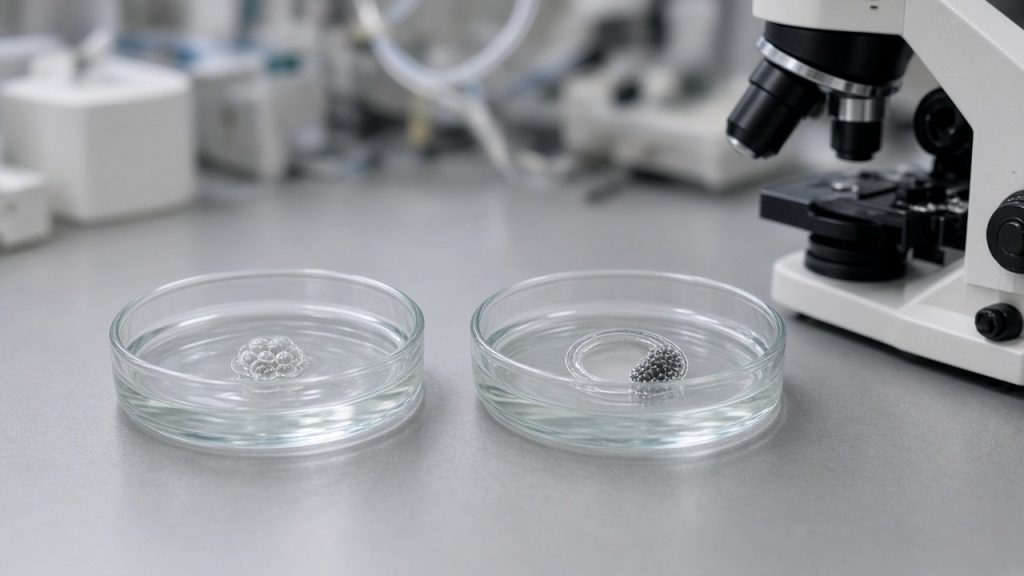
Day 3 embryos are cleavage-stage, eight cells or so, still compact. Day 5 embryos are blastocysts with a visible inner cell mass and trophectoderm shell. Labs choose when to transfer based on culture conditions, clinic philosophy, and whether they want extra days of natural selection in the dish.
Neither day is universally “better.” Day 5 transfer allows more embryos to self-select out before entering the uterus, which can improve per-transfer rates when the lab culture system is strong. Day 3 transfer may help when few embryos exist, when the uterus is ready earlier in a fresh cycle, or when historical lab results favor cleavage-stage moves.
How stage changes your due date (not your “success”)
Dating cares about stage at catheter placement. A Day 3 transfer starts two days “behind” a Day 5 transfer on the gestational calendar, meaning the due date is two days later, not earlier.
| Transfer stage | Days from transfer to due date | Weeks pregnant 14 days post-transfer |
|---|---|---|
| Day 3 | 263 | 4 weeks 3 days |
| Day 5 | 261 | 4 weeks 5 days |
Extended culture to Day 6 or Day 7 adds further offsets, covered separately in Day 6/7 blastocyst due dates. Do not lump all blastocysts into Day 5 math.
Decision factors clinics weigh
Embryo number and quality. With many embryos, waiting to blastocyst stage filters weak ones. With one or two, early transfer avoids losing the cohort in culture.
Fresh vs frozen. Fresh Day 5 transfers require synchrony between endometrium and blastocyst. Frozen cycles decouple timing, many programs now freeze all and transfer later at blastocyst stage.
PGT-A. Biopsy usually requires blastocyst stage; those embryos are transferred in a subsequent FET after results return.
Patient history. Repeated failed Day 5 transfers may prompt a cleavage-stage trial, or vice versa, evidence is case-specific, not one-size-fits-all.
Whatever stage you transfer, document it for dating. Mixing Day 3 and Day 5 labels on insurance forms creates ultrasound mismatches later. Use the FET calculator offsets for paperwork checks.
Cohort scenarios: when the lab picks for you
All embryos slow on Day 5. The lab may extend culture to Day 6 for the whole cohort. Your due date uses the stage at transfer, if nothing is transferable until Day 6, you are a Day 6 cycle for dating even if you hoped for Day 5.
Mixed speeds. Some patients transfer one Day 5 fresh and freeze slower siblings for later FET at Day 6. Each transfer gets its own EDD math; they are not interchangeable.
Zero blastocysts. A canceled fresh transfer shifts planning to a later cycle, emotionally costly, but not a dating issue until something actually transfers.
Historical clinic preference matters: some programs built reputations on cleavage-stage fresh transfers in the 1990s; others never transfer before blastocyst. Ask how your lab’s current culture system performs at each stage for your age group, registry data is national, lab performance is local.
When comparing due dates between a prior Day 3 child and a current Day 5 pregnancy, the Day 5 EDD will be two days earlier at the same transfer calendar date. Siblings can share a transfer anniversary and still have different due dates, normal, not an error.
Frequently asked questions
Can a Day 3 embryo become a Day 5 embryo in the uterus?
Development continues after transfer, but dating locks at the stage when placement occurred. You do not “upgrade” from Day 3 to Day 5 for calendar purposes.
Is miscarriage risk higher with Day 3?
Outcomes depend on age, embryo quality, and lab, not day label alone. Ask your clinic how their own data compare for your situation.
Why is my due date later with Day 3?
The embryo was younger at transfer, so more gestational time remains until 40 weeks. That is correct math, not a penalty.
Does single vs double transfer change dating?
Dating uses embryo stage, not count. Twins share one EDD unless discordant stages were transferred, uncommon.
Sources
Tools: IVF due date calculator · FET calculator · Android app
Day 3 vs Day 5 Embryo Transfer is clinic-specific. Use this as a checklist for questions, not as a diagnosis.
Educational guide only — not medical advice. If your clinic chart disagrees with a date here, use the clinic chart. For pain, heavy bleeding, or fever, call your clinic’s after-hours line.