
Edited October 2026 by Dr. Farhan. Educational guide, not a consult.
Egg freezing and IVF start in the same place: the same clinic waiting room, the same injections, the same egg retrieval. They split at the moment the eggs leave your body. Freezing eggs (oocyte cryopreservation) stores unfertilized eggs for a future you cannot see yet, maybe a different partner, no partner, or a medical treatment that threatens fertility. IVF fertilizes eggs now because you want a child on a nearer timeline. Neither is the smarter or braver choice. They are different tools for different calendars, and the right one depends on your age, your partnership, your diagnosis, and your money.
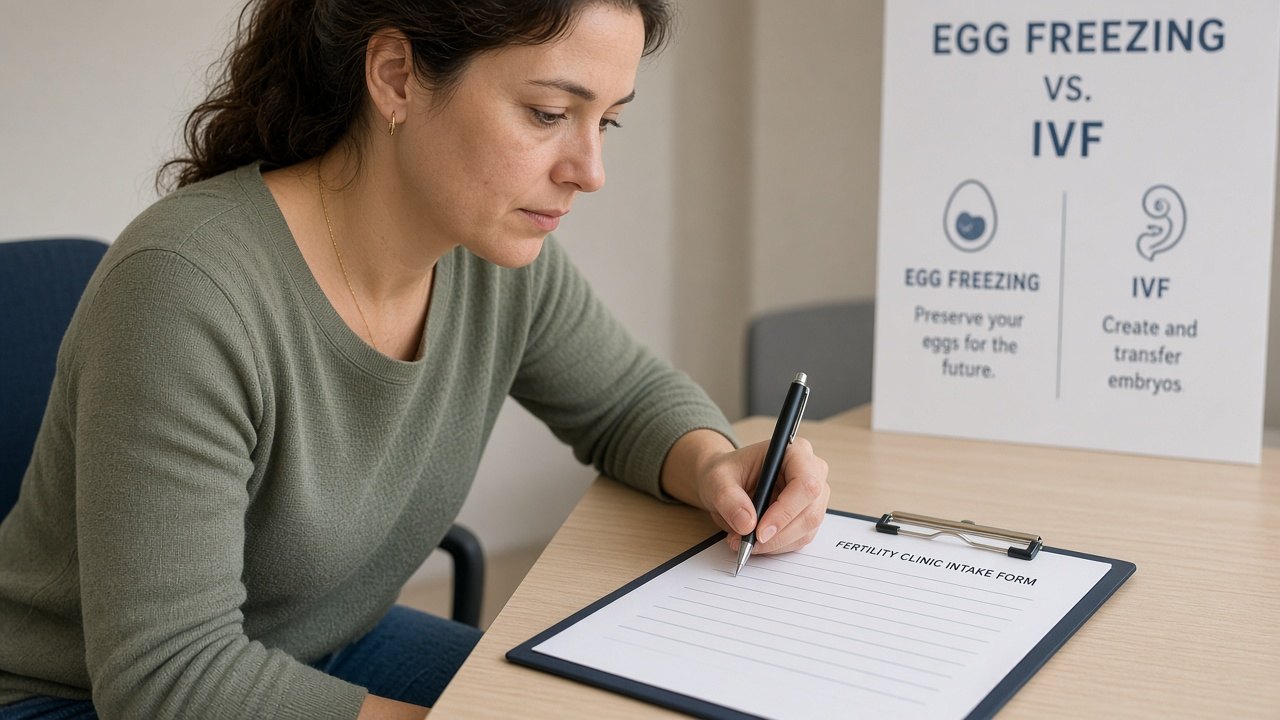
The two journeys, side by side
Because the first half of both paths is identical, it helps to see exactly where they diverge:
| Stage | Egg freezing path | IVF path |
|---|---|---|
| Testing and planning | Ovarian reserve testing (AMH, antral follicle count), infectious disease screening | Same, plus semen analysis and often a mock transfer or uterine evaluation |
| Stimulation | Hormone injections for about 10 to 14 days, with monitoring scans | Same injection burden, same monitoring |
| Retrieval | Eggs collected under sedation | Same procedure |
| What happens next | Eggs frozen unfertilized, usually by vitrification (fast freezing), and stored in liquid nitrogen | Eggs fertilized with partner or donor sperm the same day, embryos cultured 3 to 5 days |
| The decision point | No fertilization decisions now; you deal with thawing and embryos years later | Decide now: how many embryos to transfer, what to do with extras (freeze, donate, discard) |
| The later chapter | Thaw eggs, fertilize with ICSI (usually required, since freezing toughens the egg’s outer coating), culture, then frozen embryo transfer | Frozen transfer of stored embryos if the first transfer does not work |
Note the honest math: frozen eggs must still survive thawing, fertilize, and grow into embryos before you ever reach a transfer. Clinics should quote oocyte survival and subsequent embryo creation rates, not only “we froze 15 eggs.” Budget the later thaw, ICSI, culture, and transfer as a full IVF chapter, not a free continuation of the first invoice.
How many eggs is enough
Counseling charts map age bands to a suggested egg number for a reasonable chance of one live birth later. Those charts are not guarantees, and age at freeze drives the odds more than any marketing photo. Two retrievals may be wiser than one heroic stimulation. If AMH is low, hear that before you pay for a single cycle billed as enough.
Fertilizing later versus now
Freezing embryos requires sperm now and creates decision weight later, such as disposition if you separate. Freezing eggs keeps future flexibility but usually means lower per-thaw success than an already-made blastocyst. They are different legal and emotional objects, not different levels of commitment.
When a transfer eventually happens, date it with the IVF due date calculator using embryo age (Day 5 = 261 days from transfer; Day 7 = 259). There is no due date while eggs sit in storage; dating starts after fertilization and transfer in a future cycle.
Decision factors by age and context
| Goal | Often leans toward | Tradeoff |
|---|---|---|
| Delay pregnancy 2+ years, have eggs only | Egg freezing | Second procedure later for fertilization plus transfer |
| Try to conceive this year with partner sperm | IVF (or IUI first if indicated) | Immediate cost and treatment intensity |
| Pre-chemotherapy, no partner | Egg or embryo freezing | Embryo freezing requires a sperm source now |
| Age 38 to 42, wants multiple children later | Discuss both; may freeze eggs then IVF | See IVF over 40 expectations |
Number of eggs frozen matters more at older ages. ASRM education materials emphasize age at freeze as the dominant predictor. Two cycles may be recommended where one IVF cycle might have been enough for immediate embryo creation. Financially, compare per-live-birth cost, not only per-procedure sticker, see IVF costs.
Medical freezing (before chemotherapy, for example) is urgent and should not wait for a “perfect AMH month.” Elective freezing is a probability purchase: you are buying a chance that later IVF with those eggs will work. It can wait for a cycle without illness, without a crash diet, and with a clinic that reports thaw outcomes, not only freeze counts. If you are 37 and hoping to conceive at 38, IVF now and freezing leftover embryos may beat freezing eggs and waiting two years; if you have no partner and a career peak, eggs may fit better.
What to put in the consent forms
Disposition if you die, if you separate, if storage fees lapse, and whether research donation is allowed. These sentences are grim and they prevent courts from guessing. Storage invoices should have a calendar reminder; lost contact is how clinics send final notices you never see.
Choosing egg freezing avoids immediate decisions about unused embryos, a real benefit when partnership is uncertain. IVF creates embryos that may outnumber transfer plans, raising donation, destruction, or indefinite storage choices under clinic consent forms. Read disposition clauses before fertilization if that stress would push you toward egg-only banking now. Relationship changes during storage years matter: breakups may affect legal control of frozen eggs or embryos depending on consent signatures at freeze. Update clinic contact information and authorized pickup persons to prevent billing lapses that threaten storage. If you relocate, shipping eggs between clinics requires courier contracts and thaw survival risk disclosure.
Oncology fertility preservation timelines may allow only one retrieval before treatment that harms fertility; choose egg versus embryo based on whether partner sperm is available and relationship stability, within days, not months. Fertility preservation nurses specialize in these compressed decisions; general IVF coordinators may not. Employer coverage for fertility preservation sometimes covers egg freezing but not future thaw IVF, so read the policy for both phases before assuming one authorization covers the full journey.
Questions to ask before you decide
- What is your clinic’s egg thaw survival rate for women my age, not the national average?
- For my age and egg number, what is a realistic expectation of one live birth from a single retrieval?
- Would you recommend one cycle or two, and how would you decide between them?
- If I freeze eggs, what will the thaw, ICSI, culture, and transfer cost later, in today’s prices?
- What happens to my eggs if I miss a storage payment, move abroad, or change my contact details?
- If I have a partner now, would making embryos today be statistically kinder than freezing eggs alone?
Frequently asked questions
Is egg freezing ‘gentler’ than IVF?
Stimulation is similar; egg freezing skips fertilization and transfer. The injection burden overlaps heavily.
Can I freeze eggs and do IVF in the same cycle?
Sometimes a partial freeze plus fertilizing the remainder is possible if enough oocytes are retrieved; clinic dependent.
How long can eggs stay frozen?
Years to decades with ongoing storage fees and renewed consent; quality at freeze age matters more than storage duration within lab standards.
Does insurance cover egg freezing?
Often only with medical indication; elective social freezing is usually out-of-pocket. Verify benefits.
Walk the full arc in our IVF process overview even if today you only freeze; it previews the later half you may enter.
Sources
- ASRM: Fertility preservation
- ACOG: Oocyte cryopreservation
- HFEA: Egg freezing
- NCI: Fertility and women’s cancers
Freezing eggs is a bet on your future self; IVF is a bid on the present one. Whichever you are leaning toward, take this page to your consultation and let your clinic run both plans on a whiteboard with real costs. That conversation is worth more than any article, including this one.
Educational guide only — not medical advice. If your clinic chart disagrees with a date here, use the clinic chart. For pain, heavy bleeding, or fever, call your clinic’s after-hours line.