
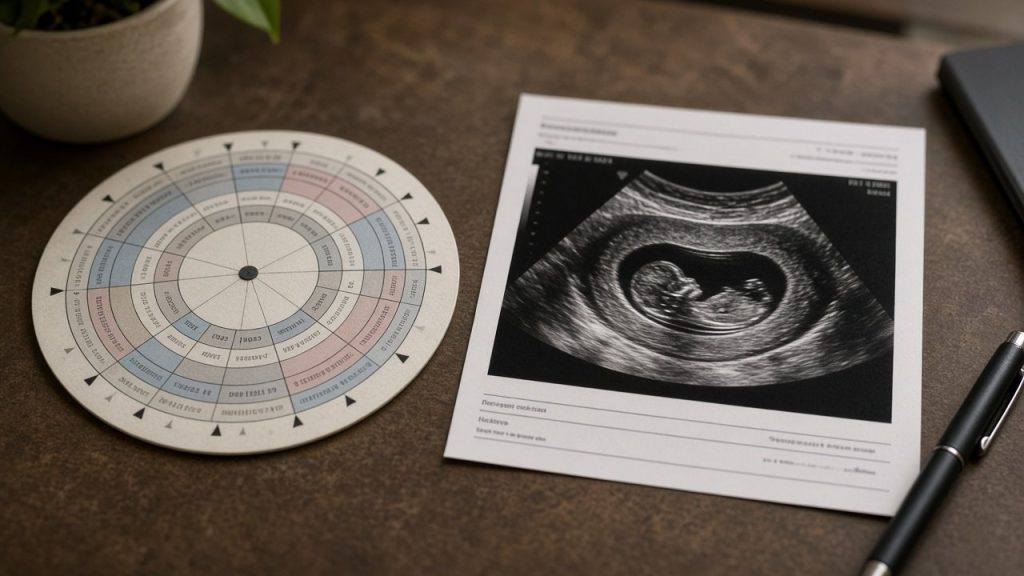
September 2026 update. Dr. Farhan. Confirm numbers with your clinic.
Updated September 2026 · Educational, not medical advice. Confirm with your clinic.
The IVF due date vs ultrasound question comes up at the first scan, which often disagrees with the transfer calendar by a few days. That is not automatically a reason to throw out the IVF due date. Fertilization day was observed in a dish. A crown-rump length chart is a statistical average of many pregnancies, some of which were dated from a guessed period.
Clinics still look at the scan. They are checking that there is a pregnancy in the uterus, that it is growing, and that the number of sacs matches what they transferred. Dating is the second conversation, not the first.
Why IVF dating is usually the anchor
For a spontaneous pregnancy, ultrasound in the first trimester is often more accurate than a remembered LMP. After IVF, the information hierarchy flips. You already have fertilization timing and embryo age. Many clinics keep the IVF-calculated EDD unless the ultrasound is off by a larger margin (often around a week, though your team’s cutoff is the one that matters).
A Day 5 transfer dated with +261 days is already about 2 weeks 5 days on transfer morning. A viability scan “at 7 weeks” is therefore about 4.5 weeks after transfer, not 7 weeks after transfer. People who count from transfer as week zero think the scan is early. It is not. They are on two different clocks.

When teams do change the date
They may revise when growth is clearly behind or ahead of the IVF age, when the embryo-day documentation is missing, when there are twins with different measurements, or when a later anatomy scan plus clinical picture argues for a new plan. They should tell you which date will be printed on admission paperwork. Home calculators should follow that printed date, not the other way around.
Twins after a single embryo (splitting) still start from the same transfer math. Two embryos of different ages would be unusual; if it happened, ask which embryo the chart uses. See also twins after IVF.
CRL charts were not built only on IVF pregnancies
Ultrasound machines interpolate size to gestational age using tables from mixed populations. A genetically smaller or larger embryo can sit a few days off without being wrongly dated. That is one reason a 3-day gap at 6-7 weeks is a discussion, not an emergency by itself, bleeding, pain, or no heartbeat is a different category and belongs to your clinic, not a website.
How to compare the two numbers calmly
- Write down transfer date and embryo day from the lab sheet.
- Run them through the IVF due date calculator (FET: transfer, not freeze).
- Write the ultrasound gestational age and the date of the scan.
- Ask the clinic which EDD they will keep, and whether they want another scan before changing it.
Do not edit your hospital file from a forum screenshot. For how weeks unfold after that first scan, first trimester after IVF is the next read.
Two clocks, one pregnancy
After IVF you may carry two due dates: one calculated from transfer date and embryo stage, another suggested by an early ultrasound measuring crown, rump length (CRL). They often disagree by a few days. That gap alarms patients who assume ultrasound is always “more accurate.” In IVF, transfer-based dating is usually the anchor because the embryo’s age at placement is known within a day. Ultrasound is a check, not a automatic override.
Disagreement is normal early on. Measurement error, curve choice, and slight variation in implantation timing all matter. Problems arise when a portal silently replaces the IVF date with scan math without telling you, or when a new provider treats any difference as proof the fertility clinic was wrong.
When teams keep the IVF due date
Most programs retain transfer-based dating if the ultrasound estimate is within roughly five to seven days. Reasons include:
- Embryo stage at transfer is a fixed input; CRL at six weeks has a measurement margin of error near ±4-5 days.
- Changing the EDD shifts every future scan window and may trigger unnecessary “growth concern” labels.
- IVF pregnancies are often dated consistently from the start so research registries and NICU statistics stay comparable.
Example: Day 5 transfer EDD is October 12. A six-week scan suggests October 9, three days earlier. Many clinics keep October 12 and note “dates consistent with IVF.”
When teams actually change the EDD
A new due date is more likely when:
- The gap exceeds a clinic’s threshold (commonly seven days or more at the dating scan).
- Transfer records were wrong, e.g., Day 6 entered as Day 5, and ultrasound repeatedly disagrees.
- There is true biological variation: late implantation can make early CRL look “small” even when IVF dating is technically correct; teams weigh trends over one measurement.
- Non-IVF dating rules apply after loss of records or donor cycles where only scan data exists.
| Situation | Typical clinic approach |
|---|---|
| ≤5 days difference at 6-9 weeks | Keep IVF EDD; document scan consistency |
| ≥7-10 days difference, repeatable | May revise EDD after repeat scan or chart review |
| Twins with different CRL | Often keep IVF date; monitor each fetus on its curve |
| Wrong embryo stage on paperwork | Fix stage first, then reconcile, not the other way around |
Bring your transfer summary to every scan. Sonographers often re-date from CRL by default because most patients do not know embryo stage. A one-line note , “Day 6 FET, EDD per IVF”, prevents accidental overwrites in the electronic record.
How to talk with your team when numbers diverge
Ask three plain questions at the dating scan: (1) What CRL measurement did you use? (2) What due date does that imply? (3) Are we keeping the IVF due date or changing it today? Write the answers in your phone notes. If the sonographer cannot answer policy questions, the ordering clinician can, usually your fertility doctor early on, later your OB.
Patients who freeze embryos in one state and deliver in another see this friction most often: new systems default to LMP fields. Upload the transfer summary to the patient portal before the first OB intake. If a revised EDD is chosen, ask whether induction or “post-dates” monitoring thresholds move with it, those operational details matter more than the abstract calendar date.
Frequently asked questions
Is ultrasound or IVF dating more accurate?
IVF dating is more precise about when pregnancy began because embryo age is known. Ultrasound validates growth but has its own error band. Neither is “wrong”; they answer slightly different questions.
Should I change my app if the scan differs?
Only if your clinician officially changes the EDD. Apps that rely on LMP often drift regardless; see pregnancy app pitfalls for IVF.
Does a smaller-than-expected CRL mean miscarriage?
Not by itself. One measurement below the mean triggers follow-up, not a diagnosis. Trending hCG and repeat scans matter more than a single day’s discrepancy.
Who has final say on the due date?
Your obstetric team managing delivery planning. Ask them to document which EDD is active and why, especially at the fertility-to-OB handoff.
Sources
- ACOG. Methods for estimating the due date
- SMFM. Role of ultrasound in pregnancy dating
- ISUOG. Ultrasound assessment guidelines
Tools: IVF due date calculator · FET calculator · Android app
IVF Due Date vs Ultrasound Due Date is clinic-specific. Use this as a checklist for questions, not as a diagnosis.
Educational guide only — not medical advice. If your clinic chart disagrees with a date here, use the clinic chart. For pain, heavy bleeding, or fever, call your clinic’s after-hours line.