
September 2026 update. Dr. Farhan. Confirm numbers with your clinic.
Some clinics schedule a mock embryo transfer weeks before your real IVF or frozen transfer. It sounds like an extra appointment you did not budget for, emotionally or on the calendar, but the goal is simple: learn the route into your uterus when nothing is on the line.
On transfer day, the embryologist has already done the hard part. The nurse has a narrow window, a full bladder protocol (at some centers), and a patient who has not slept. A mock run lets the team measure cervical curve, uterine depth, and whether a softer or firmer catheter works best, without an embryo in the dish.
What actually happens at a mock transfer
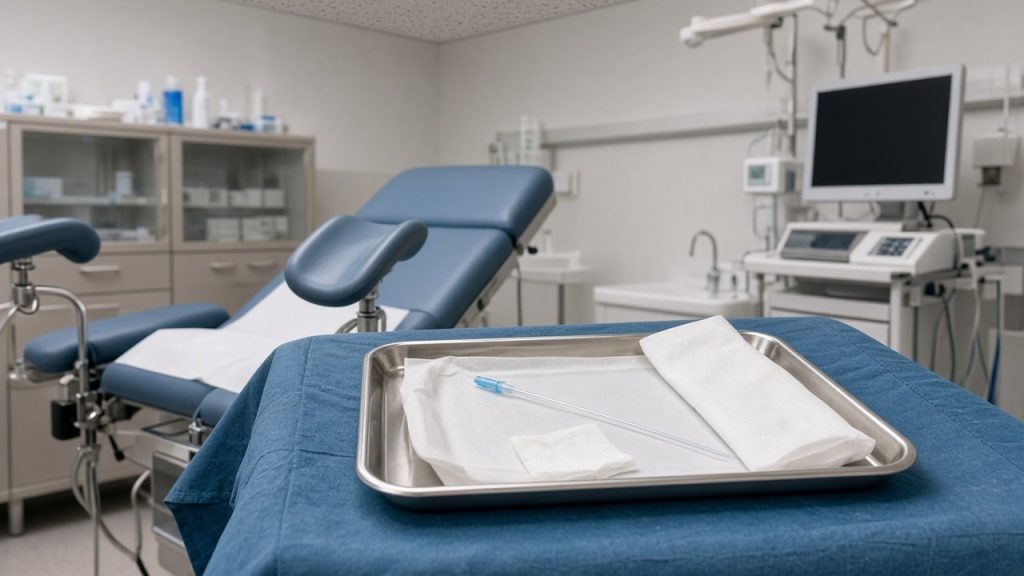
You lie in the same room you will see later. A nurse or doctor passes an empty catheter through the cervix while ultrasound guides placement. There is no anesthesia in most cases; it feels similar to a pap smear or IUI catheterization, crampy for a minute, awkward always, catastrophic rarely.
They may note:
- Whether your cervix needs dilating on the real day
- If a tenaculum (gentle clamp) helps when the canal is angled
- How far the catheter should advance for mid-cavity placement
Photos or sketches sometimes go in your chart so a different doctor on transfer morning can follow the same map.

Mock transfer vs saline sonohysterogram (SIS)
Patients confuse these constantly. A saline infusion sonogram pushes fluid to outline the cavity and look for polyps or septums. A mock transfer uses an empty catheter to rehearse physical access. You might need both in a work-up year; they answer different questions.
Who usually gets one
Not every clinic routine-orders mocks. They show up more often with prior difficult transfers, known fibroids near the cavity, certain uterine shapes, or before a frozen cycle when the fresh retrieval doctor will not be the one transferring. Ask whether your center treats it as standard or optional, either answer is normal.
Does it improve pregnancy rates?
Studies are mixed. The clearer win is fewer surprises on the day that counts: less time with an embryo outside the incubator, less cervical trauma, less last-minute switching to a different catheter while you stare at the ceiling. That is worth something even if statistics barely move.
Practical tips from patients who have done both
Wear the same comfortable clothes you plan for transfer. Take the prescribed ibuprofen if they offer it for cramping. Bring a pad, spotting happens. Most importantly, treat the mock as information gathering, not a grade. A tricky mock does not mean the real transfer will fail; it means the team prepares tools you never knew existed.
Questions worth asking your nurse
- Will the same physician perform my real transfer?
- Should I have a full bladder today or an empty one?
- If today is difficult, what is Plan B on embryo day?
Once you are pregnant, dating still comes from the real transfer date and embryo stage, not the mock. Offsets live in our FET due date guide and homepage calculator.
Quick answers
Is a mock transfer mandatory? No, clinic-dependent.
Can I drive after? Usually yes unless you took sedation (uncommon for mocks).
Will insurance pay? Often bundled into IVF diagnostics; verify billing codes.
Does it affect the two-week wait? No embryo is transferred; there is no TWW from a mock alone.
Tools: IVF due date calculator · Android app
What happens during a mock embryo transfer
A mock embryo transfer is a rehearsal without an embryo. In the same exam room where your real transfer will occur, the physician or embryologist passes a soft catheter through the cervix into the uterine cavity, often using ultrasound guidance and an full bladder, identical to transfer-day logistics. No anesthesia is required for most patients; it feels like a pap smear with extra fullness and a brief cramp when the catheter reaches the fundus. The team measures cervical length, notes uterine angle, and sometimes marks depth on the catheter so transfer day is faster and less stressful. Mock transfer is not ERA biopsy (which samples lining tissue for receptivity timing) and not a hysteroscopy, it is purely anatomical mapping.
Clinics order mock transfers for various reasons: sharply anteverted or retroverted uterus, prior difficult IUI or transfer, cervical surgery history, or simply standard protocol at high-volume centers. Knowing the route before embryos are thawed reduces panic on the real day. Confirm with your clinic whether your mock happens in a separate month or immediately before stimulation, scheduling differs.
Mock transfer vs real transfer vs ERA
| Procedure | Embryo used? | Primary purpose |
|---|---|---|
| Mock transfer | No | Map cervix/uterus path |
| Real embryo transfer | Yes | Place embryo in uterine cavity |
| ERA biopsy | No | Timing of lining receptivity |
| Hysteroscopy | No | Visualize cavity, treat polyps/septum |
After mock transfer, you may spot lightly or cramp for hours, similar to post-transfer cramping but without luteal medications unless you are already in a cycle. There is no two-week wait because no pregnancy attempt occurred. When the real day arrives, read our embryo transfer day guide for bladder prep, valium policies, and partner presence rules at your center.
Using mock transfer results on transfer day
Measurements from mock transfer may change real-day tactics: a tighter cervical os might need dilators; an acute uterine angle might require a different catheter or extra ultrasound attention. Patients with prior failed catheter passes benefit most, mock transfer converts unknown anatomy into a checklist. It does not predict implantation success; euploid embryos still fail after easy transfers, and difficult transfers still succeed. Success metrics remain embryo quality, lining, and luck beyond mapping.
For frozen cycles, mock transfer often precedes programmed FET while embryos stay vitrified. See our FET overview for how mock fits into estrogen and progesterone priming. Once real transfer succeeds, due dates follow transfer date and embryo age, mock date is irrelevant to IVF due date calculator math.
Insurance and billing vary: some plans bundle mock transfer into global IVF fees; others bill it as a separate office procedure. Ask for CPT coding before scheduling if cost matters. If mock transfer reveals a severely stenotic cervix, your team may plan cervical dilation under ultrasound before the real transfer, knowing that in advance reduces transfer-day cancellation fear. Bring a pad to mock appointment; spotting afterward is normal and not a sign of endometrial injury from mapping alone.
Frequently asked questions
Is mock embryo transfer painful?
Most patients describe brief cramping and pressure, not severe pain. Discomfort resembles IUI or pap smear with a full bladder. Tell the team if pain is sharp or persistent, confirm with your clinic.
Do all IVF clinics require mock transfer?
No. Some perform it selectively based on anatomy or history; others routine for every patient. Ask whether yours is mandatory and whether insurance covers it.
Can I have mock transfer and ERA in the same cycle?
Some clinics combine mock catheter practice with endometrial biopsy during a mock FET cycle; others separate them. Your calendar should be spelled out in writing, confirm with your clinic.
Does mock transfer improve pregnancy rates?
Evidence supports easier real transfers and reduced cancellation due to catheter problems; it is not a standalone boost to implantation biology. Benefits are procedural clarity.
Sources
ASRM. Embryo transfer practice guidance · ACOG. Infertility evaluation overview · CDC. ART patient resources
Tools: IVF due date calculator · FET calculator · Android app
Read this as background, not orders. Your after-hours sheet still wins if something feels wrong.
Educational guide only — not medical advice. If your clinic chart disagrees with a date here, use the clinic chart. For pain, heavy bleeding, or fever, call your clinic’s after-hours line.