

Last editorial pass: September 2026. Written by Dr. Farhan.
Scope: first obstetric ultrasound after IVF, when it is booked, what sac and heartbeat mean, and how scan dating compares to transfer math. Not anatomy scans or emergency bleeding work-ups. See also IVF vs ultrasound dating and beta hCG.
The first ultrasound after IVF transfer is the moment a positive beta becomes a visible pregnancy on screen, and for many people, the first time dating feels real. Clinics still anchor your chart to transfer date and embryo age, but the scan answers different questions: Is there a sac in the uterus? Is the heartbeat in range? Does anything need repeating sooner than planned?
This guide explains typical timing (not your clinic’s exact protocol), what structures appear week by week on transfer-based dating, and when ultrasound might adjust your estimated due date versus when IVF math usually wins.
Why IVF dating still starts at transfer, not at the scan
Obstetric age after IVF counts from a theoretical last menstrual period built backward from fertilization. On the morning of a Day 5 blastocyst transfer, standard charts already call you 2 weeks 5 days pregnant, even though transfer was yesterday. Day 3 is 2w 3d; retrieval or IUI is often 2w 0d. Due date math is: procedure date + 266 days − embryo age (Day 5 = +261 days).
That is why your paperwork may show a due date before you ever see a sac. Our IVF due date calculator and weeks-pregnant guide use the same offsets clinics print on transfer summaries. The first scan checks whether the pregnancy matches that timeline, it does not create the timeline from scratch.
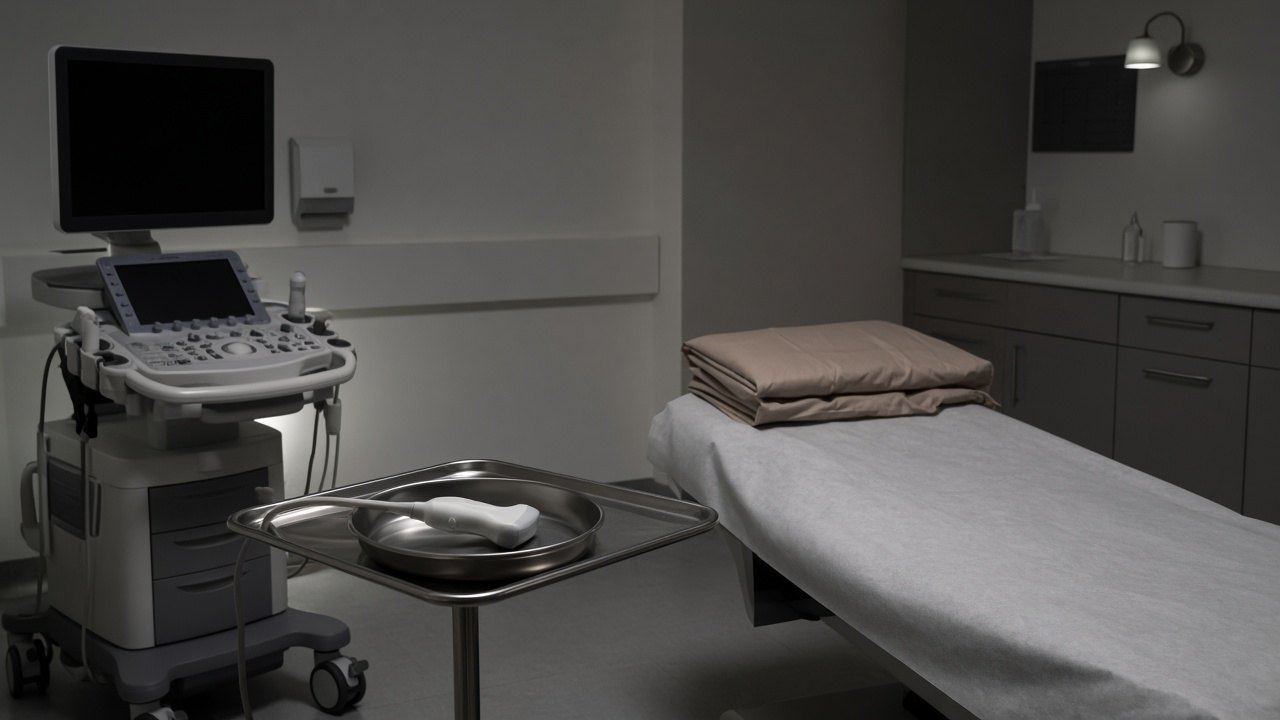
When clinics usually schedule the first scan
There is no single universal day. Most programs follow this rough sequence after a Day 5 transfer:
- Beta-hCG blood test, often 9-14 days after transfer (see our beta guide)
- Repeat beta, if the first value is low or borderline, 48 hours later
- First transvaginal ultrasound, commonly when beta rises appropriately, often around 6-7 weeks gestational age on the IVF chart (roughly 3-4 weeks after transfer for many clinics)
Some centers scan earlier to rule out ectopic pregnancy when beta rises slowly or symptoms appear. Others wait until heartbeat is likely visible to avoid unnecessary anxiety from empty sacs that are simply too early. Ask your nurse for their threshold , “six weeks” on an IVF chart is not six weeks since transfer.
What you may see at each stage (transfer-based weeks)
Findings vary. Absence of a heartbeat at one appointment often means come back in a week, not immediate loss, but only your clinician interprets that in context.
| IVF gestational age (approx.) | Common findings | What clinics watch |
|---|---|---|
| 5 weeks (e.g. ~1 week after Day 5 transfer) | Small intrauterine gestational sac may appear | Location in uterus; rule out obvious ectopic if beta positive |
| 6 weeks | Yolk sac; possible fetal pole | Sac size vs dates; repeat if empty |
| 6-7 weeks | Fetal pole; heartbeat may be seen | Heart rate trend, sac growth |
| 7-8 weeks | Heartbeat expected; crown, rump length (CRL) measurable | CRL compared to IVF dates |
Twins after IVF may show two sacs early; a second heartbeat can appear days later. Vanishing twin patterns exist, dating usually stays with the surviving pregnancy’s IVF transfer date unless your team documents otherwise.
Heartbeat timing: what “normal” usually means
Heart activity is often first detected around 6-7 weeks on IVF dating, sometimes a few days earlier or later. A slow rise at the first visit may lead to a repeat scan in 7-10 days rather than immediate intervention. One slow measurement is not a diagnosis; serial scans and betas matter.
Do not compare your scan to someone else’s Day 5 transfer in a forum. Different labs, different beta cutoffs, and different ultrasound policies change the calendar.
When ultrasound can change your due date, and when it usually does not
Because IVF documents conception timing, many teams keep the transfer-based due date if a first-trimester scan agrees within about five to seven days. Larger gaps may prompt discussion about adjusting the official EDD, especially if ovulation or IUI timing was less precise than a known blastocyst transfer.
Our detailed comparison lives in IVF due date vs ultrasound due date. Key takeaway: first-trimester CRL is the strongest ultrasound dating tool; later scans are poor at resetting due dates. If your scan EDD differs by a few days, that is a chart conversation, not something to silently change in a consumer app.
After you have dates, you can compare scan CRL in the optional panel on our homepage calculator or in the Android app, educational only, not a replacement for the sonographer’s report.
First scan after FET vs fresh transfer
Dating math is the same. FET uses the thaw-and-transfer day, not freeze date. Emotional timing differs: FET patients rarely still have swollen ovaries; fresh transfer patients may still be recovering from retrieval. OHSS concerns belong to the retrieval week, not necessarily ultrasound week. See FET overview for calendar prep.
Red flags: when to call before your scheduled scan
- Severe one-sided pelvic pain, shoulder pain, or dizziness with a positive beta, possible ectopic pregnancy
- Heavy bleeding with clots and cramping, your clinic may move scan earlier
- Fever or foul discharge, infection work-up, not routine dating
Mild spotting after transfer is common and does not automatically mean an emergency scan; see spotting after transfer for context.
How to prepare for the appointment
- Bring transfer date, embryo stage (Day 3 / Day 5 / etc.), and beta results, apps that default to LMP will confuse the sonographer if you do not have IVF paperwork
- Transvaginal scans usually require an empty bladder; follow your center’s instructions
- Ask whether a partner can record audio of the heartbeat, policies vary
- Write down: gestational sac size, CRL, heart rate, and whether the EDD on the report matches your IVF EDD
After a good first scan: what comes next
Many clinics release you to an OB or maternal, fetal medicine schedule with the IVF due date carried forward. NIPT may be offered around 10-12 weeks on IVF dating, see NIPT after IVF. Anatomy scan timing follows the same transfer-anchored chart; our calculator lists typical milestone windows for planning.
References
- ACOG Committee Opinion 700: Methods for Estimating the Due Date
- ACOG Practice Bulletin: Ultrasound in Pregnancy
- CDC Assisted Reproductive Technology (ART) reports
Common questions
Can I skip beta and go straight to ultrasound?
Some protocols use ultrasound when beta is ambiguous, but most IVF paths use serial beta first. Follow your clinic’s orders, home urine tests are unreliable early after IVF.
Why does my scan say 6w4d when I am “only” two weeks past transfer?
IVF gestational age includes the two weeks before fertilization on the obstetric scale. You are not “really” six weeks from transfer, the chart speaks a shared clinical language.
Will twins change my due date?
Usually not, same transfer date, though growth discordance is monitored separately. See twins after IVF.
My app shows a different due date than ultrasound. Which wins?
Your clinic chart wins. Period-based apps ignore embryo age. Read why pregnancy apps get IVF dates wrong.
Tools: IVF due date calculator · FET calculator · Android app
Read this as background, not orders. Your after-hours sheet still wins if something feels wrong.
Educational guide only — not medical advice. If your clinic chart disagrees with a date here, use the clinic chart. For pain, heavy bleeding, or fever, call your clinic’s after-hours line.